
Industries /
Manufacturing
You can't ship what you haven't built. You can't build what you haven't bought.
Raw materials get committed before the purchase order pays out. A production line goes down and the customer's delivery window doesn't move.
A new contract requires tooling and equipment before the first unit ships. Manufacturing is a capital-intensive business at every stage — and the capital gaps are as predictable as the production schedule.
We work with manufacturing contractors. We know your bank statements look lumpy even when your pipeline is full.
We match you to finance platforms who underwrite this business correctly.



The situations manufacturers actually call us about.
These aren't edge cases. They happen on production floors every week. Mach works with manufacturers who are dealing with exactly these problems right now.
The purchase order is confirmed. The materials have to be bought today. The customer pays in 60 days.
A confirmed purchase order from a commercial or government buyer is real revenue — it's just not cash yet. To fulfill it, you need raw materials now: steel, aluminum, plastics, chemicals, components. Suppliers want payment on delivery or on Net 30 terms. Your customer is paying Net 60 or Net 90. That gap — between when you buy inputs and when you collect on outputs — is the fundamental cash flow problem in manufacturing. For a $500K order, the materials float alone can be $150K–$250K.
What goes wrong without capital
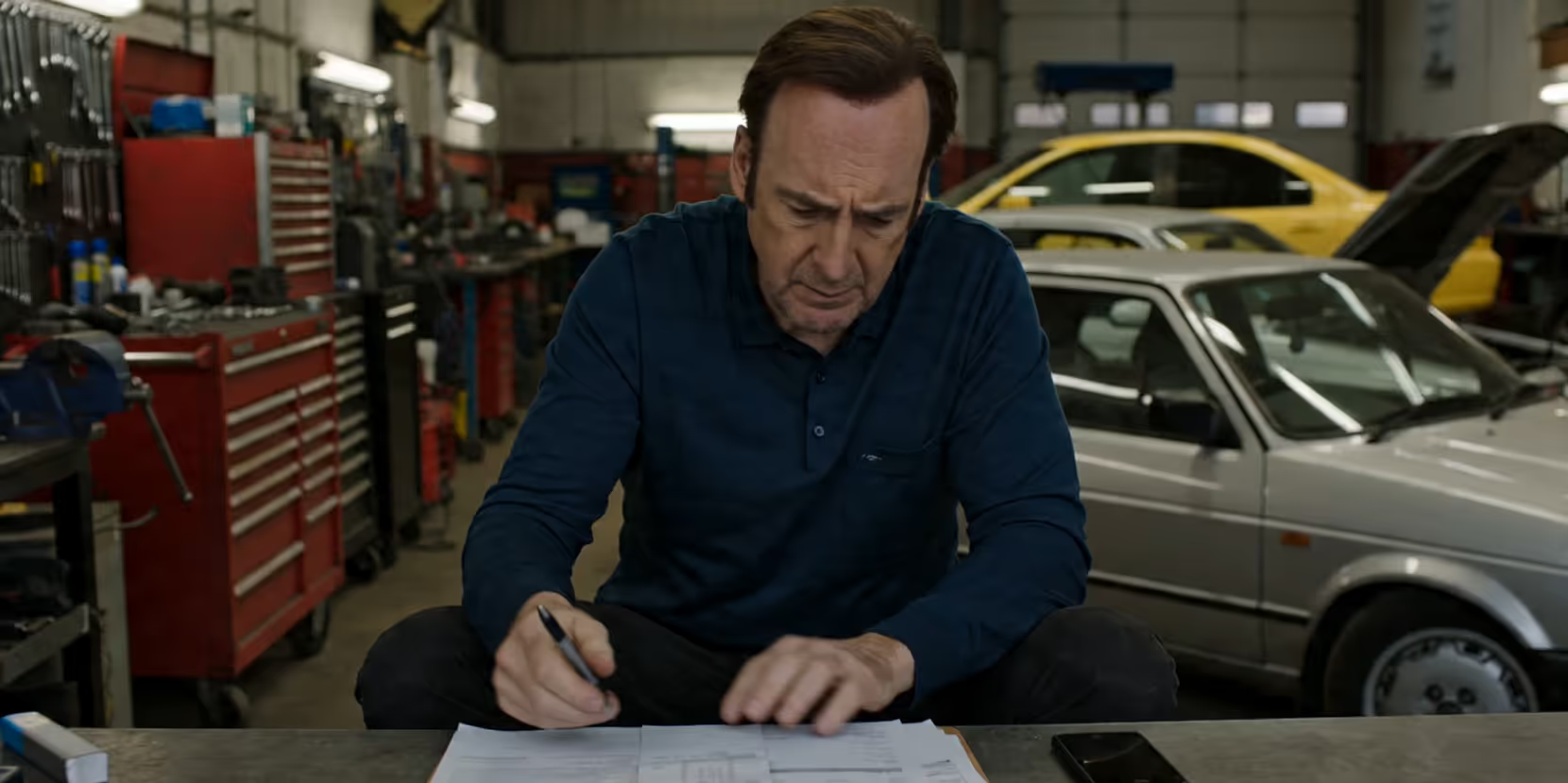
A CNC machine failed on Tuesday. The delivery schedule doesn't care.
A single piece of production equipment going down — a CNC router, injection mold press, welding system, or conveyor — can halt an entire production line. The repair bill is $15,000–$80,000. The lost production while you wait for parts or a technician compounds daily. Your customer's delivery date hasn't moved. Your penalty clause is real.
What goes wrong without capital
You won a major contract. It requires tooling and setup you don't have yet.
Landing a significant new contract from a tier-1 buyer, a retailer, or a government agency often requires custom tooling, molds, dies, or fixtures that don't exist yet — and that must be produced before the first unit ships. Tooling costs can run $30,000–$300,000 depending on the production type, and the buyer rarely funds it upfront. You front the investment. The revenue arrives per-unit over the life of the contract.
What goes wrong without capital
You run Q3 at full capacity to ship in Q4. The capital requirement peaks in August.
Consumer goods manufacturers, food and beverage producers, and industrial suppliers with seasonal demand patterns need to front the full cost of a production run — labor, materials, overhead — months before the revenue hits. The production cost curve peaks in the summer. The revenue curve peaks in the fall. Between those two curves is a capital requirement that doesn't care about your gross margin.
What goes wrong without capital



From the people we work with.
"I wasn't sure at first if this was possible or real but Noah assured me it could be done. I needed money to win a project and fast.I had to get the funds or I would lose the contract within 24 hours... Noah had me send over the documents needed to achieve the funds, Allan worked his magic, and was able to get me approved for more than what i needed! I only took what i needed now but it feels good to know that if anything changes I have access to more funds very quickly. Thank you Noah and Allan!"

"Tony Bode is excellent at his job. He is very knowledgeable and went above and beyond to offer multiple options to best fit our business needs. I would highly recommend dealing with him if business funding needs arise for your business as they did for my business. Thank you again Tony and MACH funding."

"I found out about Mach Funding about a month ago, I applied but was not approved. But the process went exactly how Kelly explained it to me. Easy process and honest people to do business with. No gimmicks a very straight forward process. Thank you to Kelly for explaining how the product works and giving me the website to apply. I will be letting my colleagues and business partners know about Mach Funding."

"I have worked with Tony from Mach. He has always gotten back to me quickly and been able to secure funds within 24 to 48 hours. I will continue to use them for my capital needs."

"I want to take the time to thanks for extraordinary customer service provided by Mac Funding team: Michael Rodriguez, Tony Bode and Azi Sharbani. Thank you for taking the time for explaining every aspect of the loan offers and obtain the best loan that fit my financial circumstance. Thank you. Thank you, and Thank you."

The questions business owners actually ask. Straight answers.
No. finance platforms in our network who work with manufacturers understand purchase-order-driven and contract-driven revenue. Your advisor looks at your production history, your order book, and your receivables profile — not just your daily card volume. The business model is well understood.
Some finance platforms in our network will fund against a confirmed purchase order from a creditworthy buyer — meaning the PO is part of the underwriting, not just an indicator. Your advisor reviews the specific buyer, the order terms, and the production timeline on the qualification call and tells you exactly which path fits.
Yes, in many cases. Many clients fund in 24–48 hours from a completed application. The Qualify Me form is 5 minutes with no credit pull. If you have a specific delivery window or penalty clause at stake, tell your advisor on the call — they know which lenders are built for urgent production situations.
Asset-based financing against the equipment itself is usually the most cost-effective path for a defined capital equipment purchase — lower rate than unsecured working capital, faster than SBA. If the investment is large enough and your financials support it, SBA is the lowest long-term cost. Your advisor walks through both options on the qualification call.
No. Seasonal manufacturing is well understood by the finance platforms in our network who work with producers. Your annual revenue profile and production history are more important than any individual slow quarter. The qualification call is where your advisor looks at the full picture.
Yes. Banks decline manufacturers regularly for patterns that are entirely normal in the industry — lumpy deposits, large outflows before large inflows, seasonal swings. The finance platforms we work with underwrite manufacturing businesses for what they actually are. A bank decline is not a Mach decline. Your advisor tells you honestly what's available on the qualification call.
Find out what you qualify for. Five minutes.
No credit pull. No bank statements at this stage. Your advisor reviews your situation and tells you honestly whether Mach can help before you commit to anything.